Do You Still Need a Website If You Have Instagram?
- Guide
- Strategy
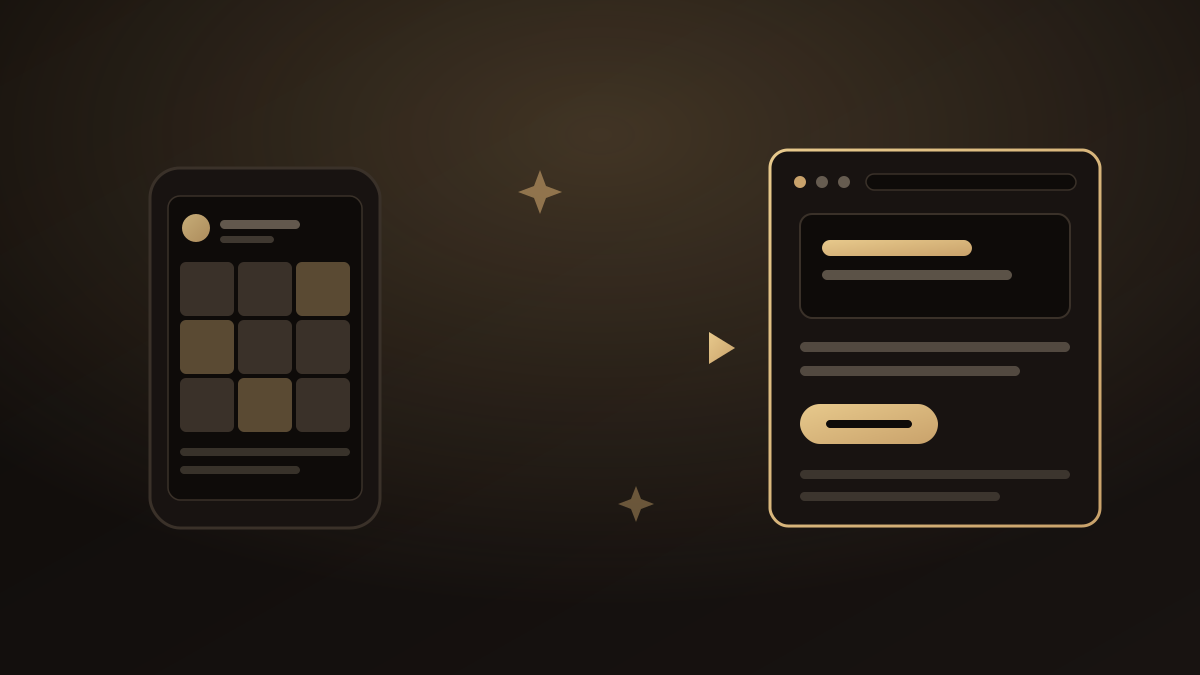
Yes, you still need a website, even with a strong Instagram. The short reason: you rent your Instagram audience, but you own your website. Both matter, and they do different jobs, so the real question isn't "which one" but "how they work together."
Across Egypt, Saudi Arabia and the UAE, plenty of businesses run entirely on Instagram or a Facebook page and do fine at first. The gaps show up later, quietly, as customers you never hear about.
What a social page does well
- Reach and discovery. The algorithm puts you in front of new people who weren't looking for you.
- Proof of life. Recent posts, followers, and comments show you're active and real.
- Fast, casual contact. DMs are low-friction, and in this region many customers prefer them.
If your business is early, visual, and impulse-driven (a home bakery, a small fashion label just starting out), a social page alone can carry you for a while.
What a social page can't do
- You don't own it. A hack, a wrongful ban, or an algorithm change can erase your audience overnight, and there's no appeal desk that answers quickly.
- It doesn't rank on Google. When someone searches "wedding photographer in Riyadh" or "gym in New Cairo," Instagram profiles rarely show up. A website can.
- It's not built to convert. A feed is designed to keep people scrolling inside the app, not to walk one visitor toward a single clear action (buy, book, or request a quote).
- It surrounds you with competitors. Every social page shows ads and "suggested" accounts, including your rivals, right next to your content.
- It caps trust. For higher-value purchases, buyers expect a real website. No site can read as "too small to take seriously."
Think of it this way: Instagram is a stall in a busy market you don't own and can be asked to leave at any time. Your website is the shop with your name on the door.
When a website becomes non-negotiable
- You sell anything high-value or considered (services, custom work, B2B, real estate, medical, education).
- You want to be found on Google, not just discovered by the algorithm.
- You run paid ads, a dedicated landing page converts far better than sending clicks to a profile. (See what makes a high-converting landing page.)
- You need payments, bookings, or a catalog that a bio link can't handle.
- You're ready to look established, because the business is.
The right answer: use both
The businesses that win don't choose. They let each channel do what it's best at:
- Social brings people in. Reach, personality, daily proof you're active.
- Your website turns them into customers. A fast, mobile-first site that ranks on Google, earns trust, and makes the next step obvious.
- Link the two. Point your bio to the site; pull testimonials and products from the site into your posts.
You don't need a huge website to start. A sharp one-page site or a small five-page site is enough to own your corner of Google and convert the traffic your social already earns. (For what that costs, see how much a website costs in Egypt, Saudi Arabia and the UAE.)
Where Ojja fits
Ojja is a digital solutions studio based in Egypt, building bilingual Arabic and English websites and online stores for businesses across Egypt, Saudi Arabia, the UAE and the wider MENA region. If you already have an audience on social and want a website that turns it into customers, book a free intro call or send your Instagram page for a free review, and you'll get honest advice within a day.